
Radon CRM in Temecula Homes: What Continuous Monitoring Really Tells You
By Orlando Martinez · October 22, 2026 · 5 min read
Most Temecula homeowners I meet aren't worried about radon. We live in sunny Southern California — earthquake country, wildfire country, occasionally flood country. Radon feels like a Midwest basement problem.
But radon isn't a regional problem. It's a geology problem, and it shows up wherever uranium exists in the soil and rock beneath a home. That includes parts of Riverside County, the Inland Empire, and the foothill communities around Temecula and Murrieta. I've walked slab-on-grade homes in Anaheim and two-story houses in San Bernardino where the only way anyone knew radon was present was by testing.
Radon is a radioactive gas you can't see, smell, or taste. It comes from the natural decay of uranium in soil and rock, and it can seep into a home through foundation cracks, slab penetrations, sump pits, and gaps around plumbing. Long-term exposure to elevated radon is a known health concern — the EPA and the Surgeon General recommend testing every home. That's the extent of what I'll say on health; for medical questions, talk to your doctor.
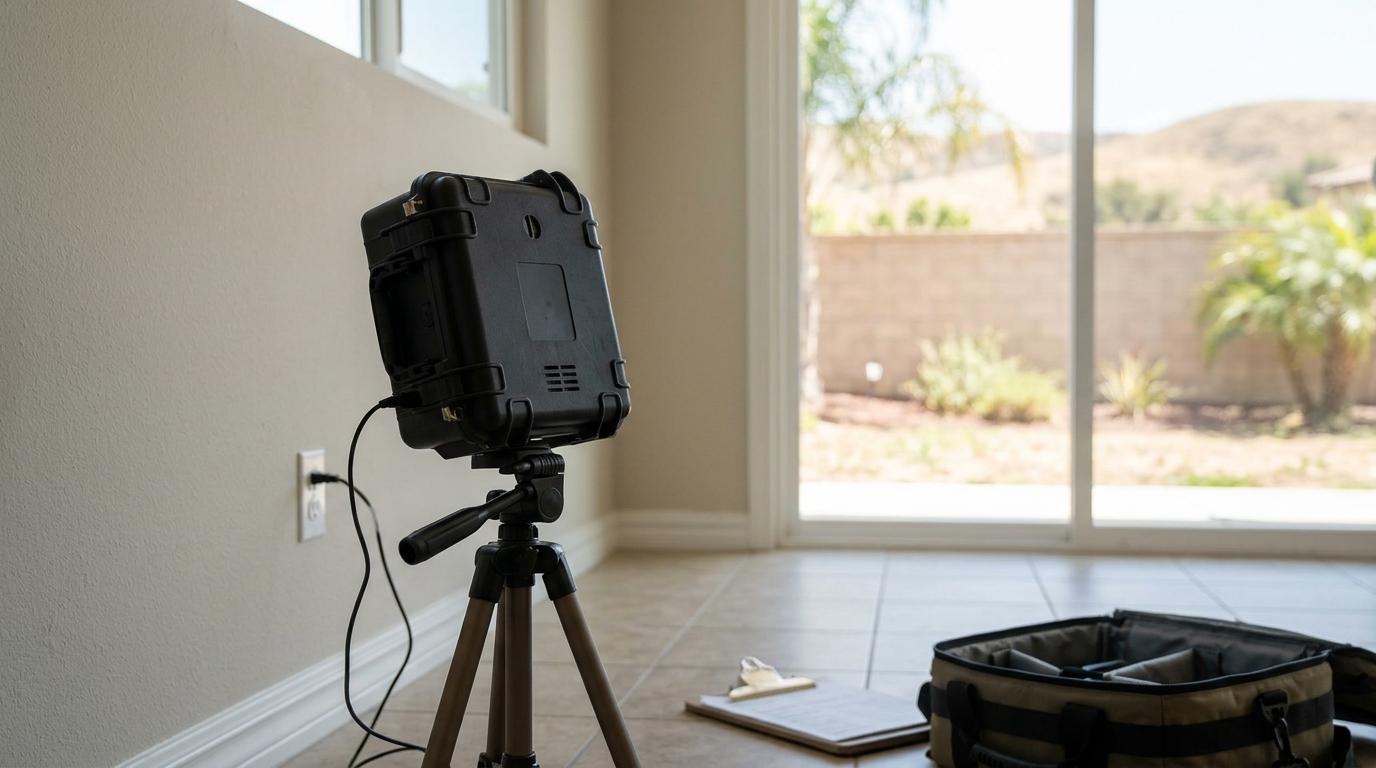
This post is about the tool we use to measure it: the continuous radon monitor, or CRM.
What a CRM Actually Is (and Isn't)
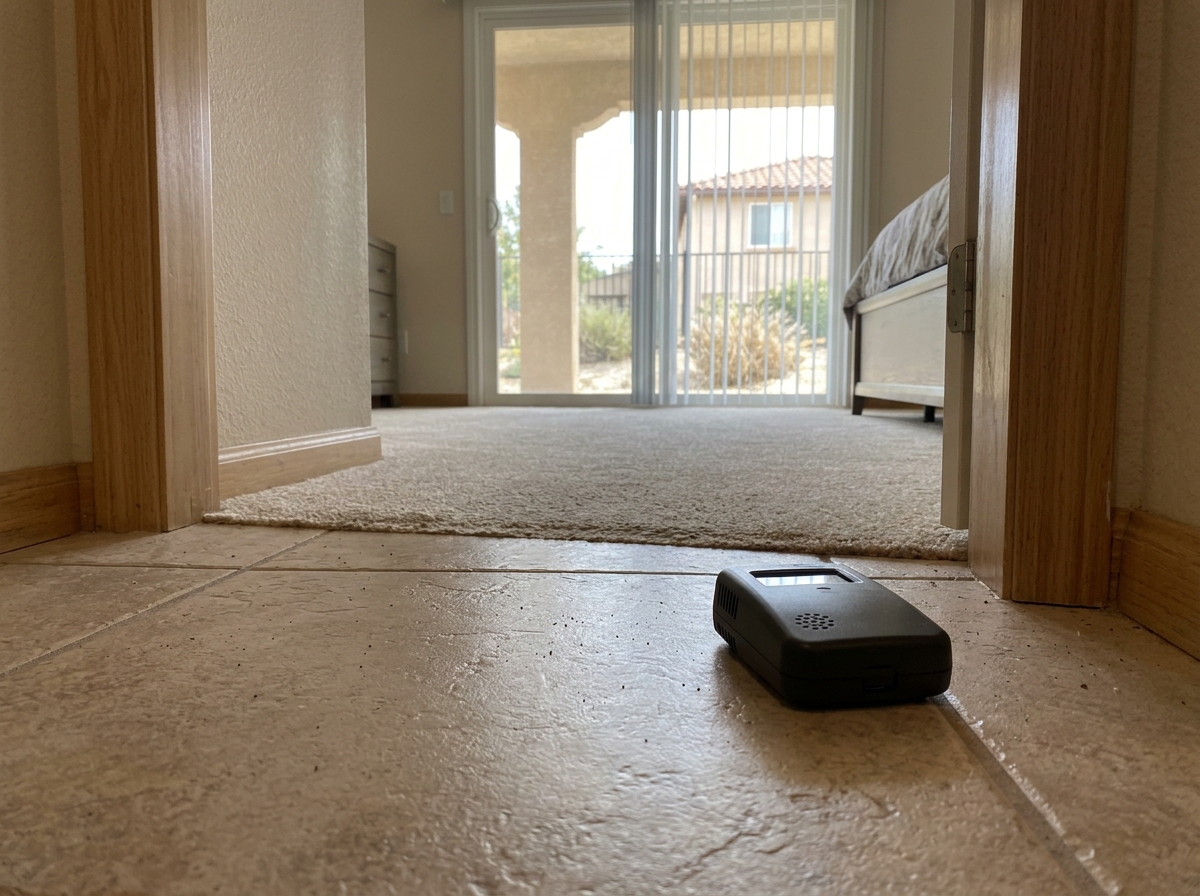
A continuous radon monitor is a small electronic device that measures radon concentration in the air over time — typically in short intervals, like hourly readings. Unlike a passive charcoal canister that gives you one averaged number after a few days, a CRM logs how radon levels move hour by hour.
That matters because radon isn't static. It fluctuates with:
- Weather — barometric pressure drops, rain, and wind can push more soil gas into a home.
- Temperature — the stack effect pulls more soil gas upward when it's cooler outside and warmer inside.
- HVAC operation — air movement and pressure differences change how much soil gas gets drawn in.
- Occupancy — doors opening and closing, windows, exhaust fans.
- Time of day — radon often peaks overnight and in early morning.
A CRM captures that pattern. A charcoal test captures a snapshot. Both are valid, but the CRM gives you the story behind the number.
What a CRM is not: a fix. It doesn't reduce radon. It doesn't tell you where the gas is entering. And it doesn't replace a proper inspection — it's a measurement tool, and its results should be interpreted by someone who understands how the home is built and operated.
Why Hourly Data Beats a Single Number
Here's a scenario I see in the Temecula area. A seller has a charcoal test done in July. The number comes back low. The buyer moves in, and by January the home feels different — and a follow-up test shows elevated radon.
Nothing changed about the house. What changed was the season, the pressure, and how the home was being used.
A CRM helps avoid that whiplash. By logging hourly readings over a minimum 48-hour period — and ideally longer — you can see:
- Whether levels are consistently low or spiking at certain times.
- Whether a closed-house protocol was actually maintained (a CRM can flag when conditions were disturbed).
- Whether the average is being skewed by a short-term event like a storm front moving through.
For real estate transactions in Riverside, San Diego, Orange County, and the Inland Empire, this is especially useful. Escrow timelines are tight. A CRM lets us run a short-term test that meets protocol while still giving us enough resolution to say something meaningful about the home.
Where Radon Shows Up in Southern California Homes
Radon doesn't care whether you have a basement. In our region, most homes are slab-on-grade or have a raised foundation with a crawlspace. Both can let soil gas in.
Common entry points I look at during inspections:
- Slab cracks and control joints — especially in older homes and post-tension slabs.
- Plumbing and utility penetrations — gaps around drains, gas lines, and electrical conduits.
- Crawlspace access — a vented crawlspace can act as a collection point that then migrates into living space.
- Sump pits and French drains — common in foothill properties where drainage matters.
- Hollow-block or unsealed stem walls — older construction, particularly in parts of Riverside and San Bernardino.
Geology matters too. Areas with granitic bedrock and certain sedimentary formations tend to have higher uranium content. That's not a guarantee of elevated radon — it's a reason to test rather than assume.
I've tested homes in Temecula, Murrieta, Menifee, and out toward the San Bernardino foothills where the geology is different block by block. You can't predict it from the address alone.
How Marine One Uses Radon Testing Alongside Other Services
Radon testing is one tool in a larger picture. When I'm at a home for Marine One Property Inspections, I'm often looking at several things at once:
- CrawlBot foundation inspection — to check the crawlspace and stem walls where soil gas can enter.
- Sewer camera scoping — because foundation and drainage issues often travel together.
- Mold and air quality testing — radon and moisture problems can overlap in the same poorly ventilated spaces.
- Thermal imaging — to spot air leakage and insulation gaps that affect how a home breathes.
For multi-unit and commercial properties in Anaheim, Riverside, or San Diego, radon monitoring can be part of a broader due-diligence package. For residential buyers and sellers, it's often a standalone test scheduled around escrow.
I hold radon and mold/air testing certifications, and I've spent 30+ years as a building and electrical contractor before moving into inspections. That background shapes how I interpret CRM data — I'm not just reading a number, I'm thinking about how the house is put together and what that number means for this structure.
What to Do With CRM Results
If your CRM results come back elevated, the next step is a conversation — not panic. Radon is manageable. Mitigation systems (sub-slab depressurization, crawlspace ventilation, sealing) are well-established and can be installed by qualified radon mitigation contractors.
A few practical notes:
- Test before you buy or sell. It's cheaper and simpler than discovering the issue later.
- Follow protocol. Closed-house conditions matter — open windows during a test will skew results low.
- Don't rely on a single short test for a permanent decision. If results are borderline or inconsistent, retest — ideally in a different season.
- Address the building envelope too. Sealing cracks, fixing drainage, and improving ventilation all help, even if they're not a substitute for mitigation.
- Talk to a qualified professional about mitigation design and any health-related questions.
A CRM gives you data. What you do with it should be based on that data plus a clear understanding of your home.
Schedule Radon Testing With Marine One
If you're buying, selling, or just want to know what's in the air at your Temecula-area home, Marine One Property Inspections can help. Orlando Martinez and the team serve Temecula, Murrieta, Menifee, Riverside, San Bernardino, Anaheim, San Diego, Orange County, and the broader Inland Empire.
We offer radon testing and monitoring alongside residential inspections, sewer camera scoping, mold and air quality testing, CrawlBot foundation inspections, drone roof inspections, pool and spa inspections, seller inspections, warranty inspections, and multi-unit/commercial work.
No hard sell — just a straightforward test, clear results, and a conversation about what they mean for your home. Reach out to schedule or to ask a question. We're happy to walk you through how CRM testing works before you commit to anything.